Recommended Sources
It is with great thanks to all the authors and speakers from whom I have learned that I offer you a shortlist of references on this important subject. I do so with hope that those not included in the shortlist will not take offense for that, if they actually ever see this list. This list is only some of the highlights from the greater set of books I have read. There are plenty of other good ones I have read and not noted here, and I know there are piles that I have not yet read. I have numerous in hand from when I had a monthly subscription to a leadership group, but at that time I was finding others on my own that were more related to what was then going on in my life. I have numerous others on my Amazon wish list too. I look forward to getting to them in time.
Some in the list below are referenced in the books of The AGAR–M2M Project, whether in the chapter devoted to leading (Chapter 10 in Math to Mettle, my broad-brushed, starting-point, scratch of the surface; a short excerpt is offered below this list) or in various other contexts. Some are written as stories (tales, allegories, fables, or parables as various of their authors refer to them) and are a very easy and enjoyable read; I have noted those at the end of their entries with “[STORY]”.
- How to Win Friends and Influence People, Dale Carnegie
- The World’s Most Powerful Leadership Principle: How to Become a Servant Leader, James C. Hunter
- Launching a Leadership Revolution, Chris Brady and Orrin Woodward
- Visioneering: Your Guide for Discovering and Maintaining Personal Vision, Andy Stanley
- The Centurion Principles: Battlefield Lessons for Frontline Leaders, Col. Jeff O’Leary
- The Compassionate Samurai: Being Extraordinary in an Ordinary World, Brian Klemmer
- Extreme Ownership: How U.S. Navy SEALs Lead and Win, Jocko Willink and Lief Babin
- Developing the Leader within You, John C. Maxwell
- First, Break All the Rules: What the World’s Greatest Managers Do Differently, Marcus Buckingham and Curt Coffman (Gallup Press)
- The Energy to Lead: The Thermodynamics of Leadership, Terry Woychowski
- The Servant: A Simple Story about the True Essence of Leadership, James C. Hunter [STORY]
- The Go-Giver Leader (previously It’s Not About You): A Little Story About What Matters Most in Business, Bob Burg and John David Mann [STORY]
- The Go-Giver: A Little Story about a Powerful Business Idea, Bob Burg [STORY]
- The Five Dysfunctions of a Team: A Leadership Fable, Patrick M. Lencioni [STORY]
- The 7 Habits of Highly Effective People, Stephen R. Covey (or as a shorter and easier read, yet quite useful … The 7 Habits of Highly Effective Teens, Sean Covey)
- The SPEED of Trust: The One Thing that Changes Everything, Stephen M. R. Covey
- The 21 Irrefutable Laws of Leadership: Follow Them and People Will Follow You, John C. Maxwell
- The Advantage: Why Organizational Health Trumps Everything Else in Business, Patrick M. Lencioni
- Lead Like Jesus: Lessons from the Greatest Leadership Role Model of All Time, Ken Blanchard and Phil Hodges
- Wooden: A Lifetime of Observations and Reflections On and Off the Court, John Wooden
- The Score Takes Care of Itself: My Philosophy of Leadership, Bill Walsh
- LeaderShift: A Call for Americans to Finally Stand Up and Lead, Orrin Woodward and Oliver DeMille
- Peaks and Valleys: Making Good and Bad Times Work for You — At Work and In Life, Spencer Johnson [STORY]
- The Four Obsessions of an Extraordinary Executive: A Leadership Fable, Patrick M. Lencioni [STORY]
Another suggestion is to consider reading biographies. Biographies of great leaders are great to read, and are a story in themselves. If you more so enjoy learning via stories, these are a good complement to those noted above. The list below is a selection of historical figures who are known for their leadership and/or overcoming of adversity (if you lead, you will face adversity). With the exception of a couple books about Ernest Shackleton, the leader of the cross-Antarctica voyage on the Endurance, which is the subject of a fantastic and inspiring story, I have not read many books that are dedicated to the life of any single individual noted below. But I have heard numerous audios/talks by others who have studied these individuals extensively. From what I have learned through those speakers, I suggest them to you; and for me… I hope to get to reading more about them someday myself.
- William Wilberforce — He was a politician of England who led the decades-long movement to eradicate the slave trade. Working for twenty years leading to the Abolishing of the Slave Trade Act of 1807, dying just three days after hearing that passage of the Slavery Abolition Act of 1833 was assured, which abolished slavery in most of the British Empire.
- Benjamin Franklin — He is a Founding Father of the United States of America and an entrepreneur publisher. Once dislikeable, he transformed himself into one of the key diplomats vitally responsible for the success of the American Revolution through securing the multifaceted support of France. Yeah, he was an inventor (as many know him to be) on the side.
- George Washington — He is a Founding Father and the first President of the United States. Prior to that he was Commander-in-Chief of the Continental Army where he was known for his dedication to his troops. He was later admired internationally for resigning as commander-in-chief at the end of the Revolutionary War rather than seizing power. He is considered by many as one of the top three U.S. presidents.
- Abraham Lincoln — As the 16th President of the United States, he is known for overcoming repeated failures and adversity in his career and ultimately for leading the United States through the enormous challenges of abolishing slavery and the Civil War. He is considered by many to be among the greatest U.S. presidents.
- Theodore (Teddy) Roosevelt — He was the 26th President of the United States, at the time the youngest president in history at age 42. He is considered by historians to be one of the greatest U.S. presidents. His face appears on Mount Rushmore along with Presidents George Washington, Thomas Jefferson, and Abraham Lincoln (pretty good company).
- Winston Churchill — He served as the Prime Minister of the UK for the years 1940 – 1945 and 1951 – 1955, where, during the former term, his critical leadership during World War II was pivotal to the survival of the Western World.
- Horatio Nelson — He was a vice admiral in the British Royal Navy, known as an inspirational leader who was courageously dedicated to his men, commanding out of love rather than authority. He died in his final victory in the Battle of Trafalgar of the Napoleonic Wars; Trafalgar Square in London is in his memory.
- Colin Powell — He reached the rank of four-star general in the U.S. Army, serving as the Chairman of the Joint Chiefs of Staff during the critical period of the Persian Gulf War, including Operation Desert Shield and ultimately Operation Desert Storm, which commenced January 16 (U.S.), 1991 (I remember exactly where I was when the news broke around dinnertime – working on my Macintosh computer in my grad-student office at U. of Illinois). He later served as National Security Advisor and the 65th Secretary of State.
- Mel Fisher — He is known for his tenacity and diligence, never giving up until he eventually found the 1622 wreck of a Spanish galleon (ship), the Atocha, off the Florida Keys, recovering an estimated $450MM of coins and jewels.
An Excerpt from My Writings
The following is the Introduction from the first book of a “short-read” book-series concept. That first book’s content is also included for my engineering design audience as Chapter 10 of Math to Mettle: Supporting, Selling, Struggling, and Surviving in the Practice of Engineering Design, entitled “To Rise or Fall — Leading (for others)”. Neither is published yet, but getting closer by the month.
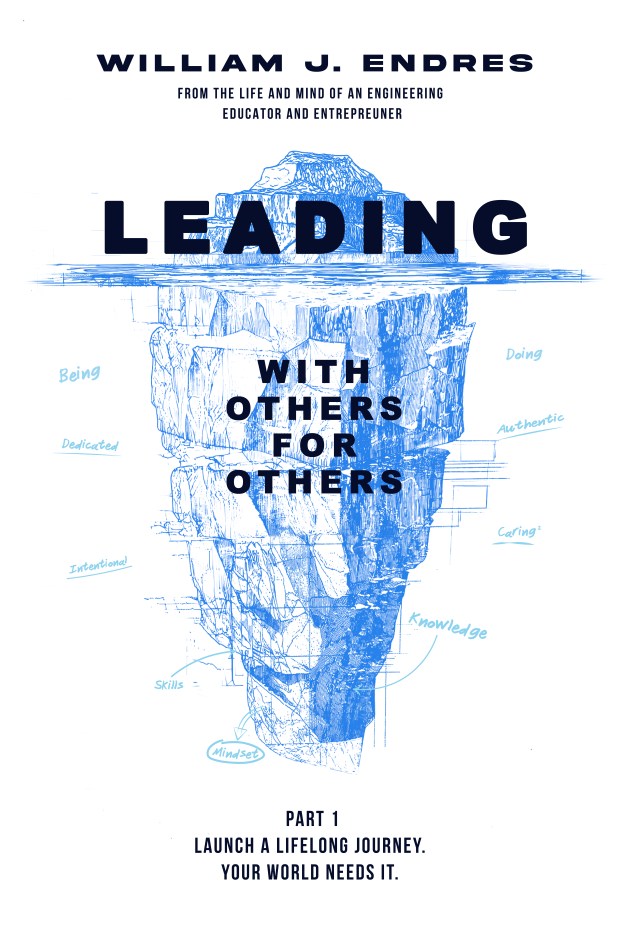
| PREFACE |
|
| Introduction | |
PART I: |
The “Why” of Leading |
| CHAPTER 1: | The Importance of Knowledge |
| CHAPTER 2: | The Importance to Teaming |
| CHAPTER 3: | The Importance of Beneath |
PART II: |
The “What” of Leading |
| CHAPTER 4: | Leading ≠ Managing |
| CHAPTER 5: | Processes |
| CHAPTER 6: | People + Process → Product |
CLOSING: |
And So Much More |
| AFTERWORD | |
| ABOUT THE AUTHOR |
© 2026 William J. Endres
All rights reserved. Except as permitted under the U.S. Copyright Act of 1976, no part of this book may be reproduced, distributed, stored in a database or retrieval system, or transmitted in any form or by any means — electronic, mechanical, photocopy, recording, scanning, or other — except for brief quotations in critical reviews or articles, without the prior written permission of the publisher.
Published by EmbetterBooks, LLC.
Introduction
As I start here, I have to first make a confession. In doing so, I am sharing something I learned over a decade ago, but of which I was sorely in need of a reminder myself…
1 All Leaders are Readers
“All leaders are readers.” That phrase, coined by Harry S Truman, the 33rd President of the United States, is a principle I’ve known for years. Yet, I’ve still fallen off track a few times and likely will again — I’m such a human. Let me share a quick story about the most recent time I needed a kick in the butt.
Since early in my AGAR–M2M book project, I’d intended to write a chapter on leadership. My intentions remained just that for quite some time, with the project waiting for me to get those first thoughts onto the screen. Part of the delay was being genuinely busy with other higher-priority activities. A greater challenge was having no publisher cracking the whip. In fact, I’d been so busy that my regular reading on leadership and related subjects had lapsed for an extended period — months, perhaps even closer to a year, to be honest.
“So what?” you might be thinking. In various places within A Game Against Reality, I’d promoted the importance of continual learning. For me, and many others, this largely comes from reading. It’s not exclusive, of course, but it’s a significant component. And here I was, not practicing what I teach, or as some might say, what I preach.
1.1 The Wake-Up Call
A stroke of luck, a reminder, or perhaps a relearning, hit me. I was reminded just how important it is to simply make time to read, even if it’s just a little bit on a regular basis. Why? All it took was opening a leadership book one Friday evening. Within half an hour, the first words that would find their way into this book were flowing onto my phone in an email to myself.
It was a Friday evening in July at the B&B. It’s usually a quiet place at that hour in that season, so I walked down for a brief bit of relaxation. I was looking for a change of environment after a couple of days battling a stubborn unrelated technical issue in my engineering business. I normally take a few pieces of paper in my back pocket to jot down notes — what a geek, right? But that evening, instead, I brought a hard-copy book that had just arrived. Most of my reading is on my Kindle or phone app, but this one wasn’t available in that format. I ordered it not because I suddenly thought, “Ya know, I need to get back to some leadership reading.” Rather, the author was someone I’d known of for many years and had the pleasure of getting to know in person over the preceding months. It seemed like another way to learn more about him.
1.2 The Profound Lesson
Wow! The lesson: I spent more time typing on my phone than I did reading. It was a good book, for sure; I nearly finished it by Sunday night. I would have finished it if I hadn’t spent so much time fleshing out parts of this book and a pretty full outline of the rest of it.
Clearly, it was more than just a good book. It was a revisiting of content I’d previously learned, now presented by that author from his unique perspective. Of course, everyone’s perspective is inherently unique as it draws upon their life lived. Consuming the same content from different sources ensures at least some difference in how the content is presented and, thus, viewed by you and me.
Consuming from a variety of sources isn’t my idea. I’d read and studied quite a bit on leadership and learned that important truth: there’s immense value in reading similar content from multiple sources with their differing perspectives. That book I opened that Friday evening got my mind rolling. And with that, pieces of this book were suddenly on screen after being only an intention for well over a year. Most people appreciate how hard it is to start with a blank sheet. Indeed, it is. At the same time, it’s much easier to edit something already written and much easier to add to something already started. So, I had now started, making moving forward easier.
1.3 Study and Practice: The Full Picture
Sidenote: Sometimes a change in direction does require a blank sheet, so don’t avoid that challenge entirely; this applies broadly, not just to leadership. Sidenote 2: If you’re not a big fan of reading (which described me until my late 30s), keep in mind there’s a lot of fantastic leadership content available nowadays in audio and video format through streaming channels and podcasts. But “fantastic” means you should be selective — not everything with the ‘L’ word in it will be rooted in sound principles.
Anyway, with that reinforcing reminder to me about “keep reading; keep learning” — hopefully also serving as evidence to you — let’s get into this enormously important subject. But first, an important disclaimer: this short-read series is truly just a scratching of the surface by someone who considers himself to have more of the leadership learning curve, and experience curve, yet to traverse. The purpose of this book, as indicated by its subtitle, is to inspire my audience to engage in a lifelong journey. My approach is to illuminate just how important sound and true leadership is to the world around us and across multiple facets of our lives. That pairing of words — sound and true — is used repeatedly in this series. It is to drive home the importance that one exercises true leadership, and does so soundly. By “true” I mean non-buzzword (boost-the-résumé, about-me-not-others, for-me-not-others) leadership, and by “sound” I mean done well.
I won’t go long when measured in relation to how important the subject is. Nor will I go deep, as scratching the surface is enough to give new readers inspiration to dig deeper, beyond the common ‘L’ buzzword you’ll see and hear widely these days. To facilitate that deeper digging, on this website [above], I provide a select shortlist of sources from which I’ve learned. Any of them would be good to include in your next steps in leadership learning through study and practice, should you choose to take those steps.
I emphasize study and practice because learning comes through both. Each is embodied in an approach that complements the other. Reading (and videos, podcasts, etc.) is the primary means of studying a subject, while implementation is the primary means of practicing that subject. While reading is good and necessary, without thinking on it and putting it into practice through implementation, it’s just reading — simply absorbing knowledge.
You might understandably think, “But you wrote that Harry Truman said ‘All leaders are readers.’” Yes, he did, but that’s just the second half of the quote. The full quote is this:
Not all readers are leaders,
but all leaders are readers.
–Harry S Truman
33rd president of the United States of America
Reading is necessary, but not nearly sufficient. Practice by implementing the knowledge learned through reading is necessary too. And like reading, implementation isn’t sufficient on its own, as often as many try to do it that way. Practice built upon weak knowledge is misguided at best, dangerous at worst. In contrast, building upon knowledge gained through study, and building skills through practice, leads to proficiency in action. With that, leadership practice brings value to the people around us. So, learn it and live it.
You should learn
as if you were going to live forever,
and live as if you were going to die tomorrow.
–John Wooden
legendary college basketball coach
2 All People Can and Should Lead
I don’t make promises or guarantees often or lightly; my kids and students can attest to that. However, with that truth on the table, I will offer one now:
If you choose to embark on a leadership journey, I promise you will reap huge dividends. These dividends will show in your life’s work and your relationships. Ultimately, your efforts will benefit those around you and bring you fulfillment at the very least, and welcome tangible results more than likely.
Knowledge of leadership, like many subjects, has at least two main components: factual and experiential. Even from the small fraction of sources I’ve consumed from those available, there’s an abundance of underlying principles (factual knowledge) and a wealth of examples, situations, and stories (experiential knowledge) from great leaders. As noted earlier, gaining knowledge from reading is necessary, but it’s not enough to make you a leader. Leadership in action is what truly makes you a leader, and that’s what the world needs. This means the knowledge in your head must be combined with skills learned and honed through practice.
There’s an important word in that previous sentence that warrants reinforcement: learn. While gaining knowledge is indeed learning, and knowledge alone doesn’t make you a leader, can one learn to lead? From countless sources and my own experience, the reality here contradicts what some say. More importantly, it may contradict what many new readers might inaccurately assume or have been misled to think.
The truth is, leaders are not born as such. Leadership is not an inherent trait or a talent you’re born with. Certainly, some of us have natural abilities and interests that lend themselves to a stronger inclination for leading. But just as someone with great height has a natural advantage over shorter individuals in becoming a great basketball player, shorter people can still become quite good. (Not me, though I could improve with more study and practice!) Consider Spud Webb, the five-foot-seven-inch winner of the 1986 NBA Slam Dunk Contest, as an extreme example. Likewise, many tall people are woefully poor at basketball, volleyball, or similar sports.
While natural abilities may give you a head start in leadership, you still need to develop those inherent characteristics to achieve leadership excellence. The good news is that all of us, regardless of our innate talents, can become better and even quite good leaders. This is because leadership primarily involves learnable elements: factual knowledge, experiential knowledge, and skills.[ * ] Ultimately, though, mature MIDACKS[ † ] leading is about mindset. As I see it, mindset is more about how you think than what you think. And knowledge —, touched upon here — “knowledgeable” being the ‘K’ in MIDACKS — provides the basis for what you think about within the framework of how you think.
And… we all can think, and we all can learn. We humans are amazing, aren’t we? This means anyone can lead. With diligent and continuous growth through study and practice, anyone can continuously improve and excel at leading. So, if anyone can lead, the question then becomes: should we lead when the opportunity arises?
To be straight with you, study, practice, and the growth that comes with them take time. So, the question of “should we lead?” is not rhetorical. We’re all busy, and we all need to prioritize, including you. Your priority list should always place the most important things at the top — the things you must do, followed by what you should do, and then what you could do. You can’t just say everything is important. As Patrick Lencioni wisely notes, “If everything is important, then nothing is important.”[ ‡ ] The most important tasks should stand out more than just the most urgent ones. By doing this, we can often prevent most activities from becoming urgent in the first place. In fact, prioritizing important tasks often helps us minimize how many things escalate to urgency.
Here’s the key: leadership is one of those very important things. As it turns out, sound leadership itself also helps minimize how much of life becomes urgent. It even allows those urgencies that appear out of nowhere to be handled with relative ease, composure, and even compassion when needed.
Anyone can benefit from that. This is indeed for all — engineers and non-engineers (i.e., the Non-normals and the Normals)[ § ] We need everyone to step up and lead in different aspects of their lives. Sound leadership is crucial for your family, your community, your church, and your company. It is important to every team, whether it’s officially called a team, like in sports, or not. Even a “team” of two often benefits when one person takes on a leadership role. Regardless of the team’s size, or whether it’s recognized as a formal team or just “a group of people” working together to accomplish something, this isn’t about “leadership” as a mere buzzword as it seems to have become. I’m talking about meaningful, intentional, dedicated, authentic, caring, knowledgeable, and skilled (MIDACKS) leading.
MIDACKS leading is a journey of regular, practical, non-theoretical study matched with continuous implementation toward continuous improvement.
So, yes, setting aside certain handicaps, anyone can lead because anyone can learn to lead. Therefore, everyone willing to learn should lead when the opportunity arises. And opportunities do arise — throughout one’s lifetime, often monthly, if not weekly. These opportunities might be small-scale or large-scale, formal positions or informal roles without a title. So, what might your opportunities be? First, you need to prepare. Then, watch for them. Finally, with humility, objectivity, and self-awareness, assess your readiness to lead compared to those around you and step up when you’re needed.
At the very least, anyone who becomes a parent has a formal leadership opportunity. This is a significant role with immense long-term impact, and many would argue it’s where true and lasting change in the world begins. As a society, we should start viewing sound parental leadership not just as an opportunity, but as an obligation — not only to the family but also to society itself.
3 A Look at MIDACKS
3.1 All the Pieces
Let’s break down the seven adjectives that form the MIDACKS acronym. The definitions chosen here are those that best fit the context of leadership.
- Meaningful: “full of meaning, significance, purpose, or value; significant.” Meaningful leadership focuses on significant and valuable impact; it is leadership that makes a difference, addressing something others care about, including those being led — the other team members — and certainly those whom the entire team aims to serve (like the “meaningfulness” of a problem that is discovered through the activity of situational understanding[ ** ] — it is a problem that others really care about, one that matters to them).
- Intentional: “done with intention or on purpose; intended.” Intentional leadership is founded on purposeful forethought and reflection in regard to all aspects of the leader’s work on behalf of those being led — the other team members — and those whom the entire team aims to serve.
- Dedicated: “wholly committed to a cause, ideal, or purpose.” Dedicated leadership puts it all on the line — the leader for the benefit of others — for the cause of leading others toward realizing a mutually embraced vision; the cause of dedication here is the leading of others and is foremost to the cause for which the team or organization exists — dedication to the latter (those whom the entire team aims to serve) derives from the leader’s dedication to the former (the other team members).
- Authentic: “true to one’s own personality, spirit, or character.” Authentic leadership is true and from the heart with transparency to those being led, leaving no room for doubt that it is those being led — the other team members — who are being served for their good and the good of those whom the entire team aims to serve.
- Caring: “feeling or showing concern for or kindness to others.” Caring leadership is first and foremost done with concern for others, those being led — the other team members — and, through them, those whom the entire team aims to serve.
- Knowledgeable: “exhibiting an acquaintance with facts, truths, or principles, as from study or investigation.” Knowledgeable leadership regularly studies the subject of leadership from multiple perspectives, repetitively over time, and, without ceasing, pursues excellence in mindset.
- Skilled: “having acquired mastery of something.” Skilled leadership continuously pursues excellence in doing by way of deliberate practice with and for those being led.
Intentional, dedicated, authentic, and caring (MIDACKS) are the products of mindset. Mindset is foundational here. A strong leadership mindset and its products (IDAC) are essential for achieving MIDACKS leadership.
However, these products and the leadership mindset they flow from also depend on sound knowledge (K) gained from studying leadership — both principles (factual knowledge) and others’ experiences (experimental knowledge). This knowledge feeds the mindset. While factual knowledge is important, experiential knowledge plays a greater role in evolving how you think, with facts contributing more to what you think about within your mindset. So, remember: mindset is about how you think, not what you think, and knowledge provides the basis for what you think about within the framework of how you think.
Finally, skills (S) are the means of implementation. They are what turn “what” you think into “doing” — into action.
This brings us to “meaningful,” or more specifically mutually meaningful. We’re looking at the ‘M’ word at the start of the acronym. Meaningful refers to the end product — the characteristics of the outcomes from the team’s activities. So, if meaningfulness is about the outcome, why isn’t it at the end of the acronym?
While putting it first makes for a pronounceable acronym, the real reason is that even though it relates to the end outcomes, meaningfulness underlies the “why” behind the activity and the team’s very existence. The “why” is where everything should begin. Nothing substantial, whether solving a problem, or leading toward a vision, should start without the problem or vision being compelling, captivating, and meaningful from the outset.
The meaning of our work is realized in the outcomes — reaching the vision and accomplishing goals along the way. But this meaning must drive us from the very start, just as Stephen Covey advised by popularizing the idea to “begin with the end in mind.” At the beginning of this chain of meaningfulness are those whom the entire team aims to serve. They are the source of the problem we address or the beneficiaries — along with the team — when the vision is reached. Often, these individuals exist even before the team forms. It’s the meaningfulness of their cause that underpins everything.
Finally, while MIDACKS leaders don’t take on meaningless causes, they also avoid wasting time on meaningless tasks during the pursuit. They continuously work to eliminate the unimportant so those they lead can focus on what truly matters.
The “with Others for Others” theme — the core relationship element — is clear in the meaningful, intentional, dedicated, authentic, and caring (M, I, D, A, and C) aspects of the MIDACKS framework. Each explicitly mentions “those being led — the other team members” and “those whom the entire team aims to serve.”
To wrap this up, dedication (D), authenticity (A), and especially caring (C), and their relation to this theme, deserve some added attention.
3.2 The ‘D’ and ‘A’ and ‘C’ Words
Let’s start with the ‘C’ for caring. This ‘C’ could actually be thought of as C² (C-squared) because it involves caring for both the people and the purpose (the cause). If alliteration helps in remembering, “caring for the characters and the cause” is a way to put it.
When it comes to caring for people, it’s not just about empathy and compassion, as you might first think. It also means giving constructive feedback and, when necessary, redemptive consequences. Even if these actions might seem unkind, they’re often what people truly need. The easy path when those you lead need critique or consequences is to do nothing, but that’s rarely the right thing to do. For how often is the right thing the easy thing? If you genuinely care for your team, you’ll take on the tough job of letting them know when they’re falling short, and you’ll do it constructively and with their growth in mind.
Returning to the full acronym, placing “authentic” (A) directly before “caring” (C) does indeed create a pronounceable acronym. However, this placement is also significant because authenticity is a modifier to caring. Why? Because inauthentic caring (let’s call it IC), whether for the cause or, worse, for the people involved, is detrimental — even worse than being indifferent. Some might argue that inauthentic caring can’t truly exist, as it’s not really caring at all. If inauthentic caring amounts to one’s actions contradicting their words, how can “caring” even be applied?
Visible actions make inauthenticity clear. But worse are invisible actions and contradictory words shared behind others’ backs. These behind-the-scenes behaviors and words, unseen and unheard by others, are undeniably elements of inauthentic caring, as what appears to be caring is simply a front.
Whether seen on the surface or revealed eventually from what goes on behind closed doors, we often see inauthentic caring in those we call leaders, or who consider themselves leaders. They may hold a position or title, but they lack genuine leadership in a MIDACKS sense. You probably know what I mean; you might have seen it as a follower, or perhaps you’re even a leader doing this yourself. If you recognize this in yourself (and it’s tough to admit), the first step to becoming a sound and true leader is to make that C-change from Inauthentic Caring (IC) to Authentic Caring (AC).[ †† ] This shift will be unmistakable to those around you, just as inauthentic caring eventually becomes unmistakable.
Most people do eventually catch on to inauthentic caring. Once they do, they can become cynical and even carcinogenic to the cause, acting like tumors within the team. The longer it takes for team members to realize, the worse the cynicism and damage to the cause. That’s definitely not good!
Regarding the cause or purpose, it is deeply tied to vision. A leader casts this vision to others, often crafting it herself first (this is part of the “upfront doing” covered in Part 2).[ ‡‡ ] If a leader doesn’t care about the cause, his leadership needs work.
A sound and true leader understands their own humanity. With that, they also understand that humans generally excel at what they care about far more than what they don’t. Leading is hard; you must have a passion for the cause. You must care about the cause and, of course, the characters involved. These characters — the people — are truly critical, and we’ll discuss them soon. Of them, if those on your team latch onto the vision, they implicitly care about the cause. And a good leader should, in turn, care about what their followers care about, because the leader’s role is to support and uplift them in pursuing that vision. The leader’s messaging plays a significant role here, and the authenticity behind it is even more important.
A leader’s caring extends beyond just how he treats his team; it’s also about how his caring for the cause affects the team. It may be cliché and likely you’ve heard it before, “caring is contagious.” Followers catch a caring for the cause by way of observing the leader’s caring for the cause. And, the ultimate driver of the team’s overall dedication, often more so than the leader’s direct passion for the cause, is the leader’s caring for the individuals involved — his teammates and, through them, those whom the entire team aims to serve.
Can caring go too far? First, it’s important to understand that caring doesn’t always mean being nice or agreeable. Sometimes, true caring requires delivering difficult truths that are hard for others to hear, but are necessary for the good of the team or an individual. This isn’t to say a leader should be mean or disagreeable as a default. Instead, I’m emphasizing that a leader who truly cares will deliver what is needed, not just what is wanted. That delivery, even when handled tactfully and considerately, can still be perceived as vinegar rather than honey simply because it’s a tough truth to swallow.
Second, in regard to caring going too far, I have been asked a couple good questions: Do habitual displays of caring risk becoming inauthentic? Does automatic caring equate to inauthentic caring?
My answer is yes; automatic and authentic caring can coexist. Automatic doesn’t mean indiscriminate. Think of automated systems, like those in factories or aircraft autopilots; they don’t just perform tasks blindly. Instead, they operate based on observations from their environment, using sensors. Similarly, leaders can be predisposed to caring, sharing it openly and often — you could call it habitual or automatic — yet still do so thoughtfully. This means showing care within the specific context of the situation and considering what is socially and culturally reasonable. So, yes, automatic caring and authentic caring can indeed coexist.
Finally, while caring is crucial, it’s not always enough on its own to win the day. This brings us to dedication (D). While caring is at the root of self-motivation, or intrinsic motivation, self-motivation has its limits. Leading is hard work and comes with many challenges that will test your self-motivation. There will be low days, weeks, or even months when caring feels insufficient. In these times, dedication takes over to win the day. MIDACKS leaders, with their strong dedication, stand out because they don’t just survive hardships — they thrive through them. While dedication to the purpose is important, dedication to the people is an even greater driver, just as caring for people is a greater driver than caring for the purpose.
3.3 The Math
Yes, given that this book series is “from the life and mind of an engineer…,” there must be an attention to math. Honestly, this section wasn’t part of my initial plan for this book. It came about because I was asked — likely since I mostly work with engineers on their leadership development journey — if these MIDACKS elements are multiplicative, additive, or a bit of both. That question really intrigued me, and I’ve thought about it quite a bit since.
I’ve explored various mathematical forms, with ‘I,’ ‘D,’ ‘C,’ ‘K,’ and ‘S’ scaled from 0 to 1, and others like ‘A’ even ranging from –1 to +1 to capture the negative effects of inauthenticity. I’ve grouped them in different ways, even looking into exponential decays over time for the rate of building ‘K’ and ‘S,’ in addition to their immediate impact on potential. Honestly, I’ve done a lot of this kind of metamodeling[ §§ ] in my engineering research, so it was fun for a while. My conclusion, though, is this: it’s not math, as much as we engineers would like it to be.
We could probably find a mathematical expression that makes all the trends sensible as each element approaches zero, +1, or –1. But based on my attempts, even if I was halfway there, the mathematical expression quickly becomes unhelpful. Math is a tool for clarity and assistance; when it doesn’t serve those purposes, or worse, makes things murkier, it’s out of place. And as far as I can see, it’s out of place here.
But here is some of my early thinking in that process that might be helpful with these adjectives. Anyone can be intentional, dedicated, authentic, and caring, whether they’re a leader, engineer, physician, machinist, waitress, etc. Each of these is a valuable quality for anyone to possess. Increasing any of these (I, D, A, or C) would amplify your potential, multiplying it in some way. “Potential,” as I’m using it here, is a relative, domain-based concept, largely driven by knowledge (K) and skills (S).
For instance, take basketball. I have very little potential there now, even though I was a pretty good recreational player in my youth. I’m older, not in great shape, and haven’t shot a basketball more than a couple of times in decades. This limits my shooting and dribbling skills compared to years ago. Worse, I don’t watch basketball much, so I barely remember the rules or methods for offense and defense.
Yes, I could get better by relearning rules and methods, getting in shape, and practicing shooting. This is all about knowledge (K) and skills (S). They’re low now, but can improve with study and practice. They were higher before, but degraded without continuous growth or maintenance. Together (maybe as (K –Ko) × S = P)[ *** ], they create my potential (P) as a basketball player. As you can see, this quickly becomes complex enough to lose its usefulness, and it’s still oversimplified by only accounting for K and S!
Now, some great basketball players might be low in one or some of intentionality (I), dedication (D), authenticity (A), and caring (C), yet still excel in the basketball domain. Realistically, though, they’re likely high in I and D, as these are ingredients for greatness in any field. They might have little A and/or C, but they certainly have high K and S. This likely implies high I + D helped them get there, and helps them capitalize on their current potential.
All that said, if you multiply a small number (like K + S or P) by a huge multiplier (like I + D + A + C), you still get a low number. In other words, as mentioned at the beginning of this chapter, knowledge is necessary, and skills are too; together, they create potential. But, like potential energy that does no work, leadership potential has no impact until it’s unleashed and put into action. When intentionality, dedication, authenticity, and caring flip the switch, activating and amplifying that MIDACKS leading potential, effective MIDACKS leadership happens, resulting in an impact consistent with the potential.
Okay, nothing more useful there, in my opinion. But what is useful — and has surfaced repeatedly — is the focus on purpose (or cause) and people (or characters). There’s no math or magic here, but these are where leading begins, and they should be why it starts. So, let’s prioritize the “why” over equations and measurements.
PART I
The “Why” of Leading
It’s really important. Simply put…
Everything rises and falls on leadership.[1]
–Dr. John C. Maxwell[ ††† ]
author, speaker, pastor
CHAPTER 1
The Importance of Knowledge
Continued in the book…
[ * ] I’ve adopted this breakdown of “learnable” content from Marcus Buckingham and Curt Coffman’s book, First, Break All the Rules: What the World’s Greatest Managers Do Differently. They distinguish between these learnable elements — factual knowledge, experiential knowledge, and skills — and innate characteristics, which they define as “talent.”
[ † ] If you skipped the Preface, the MIDACKS adjective, pronounced MY-daks, is an acronym encompassing and standing for: Meaningful, Intentional, Dedicated, Authentic, Caring, Knowledgeable, and Skilled.
[ ‡ ] You can’t just say everything is important. Why? First, in general and in principle, pick an adjective ‘X’ and the following statement holds: if everything is X, then nothing is X. Patrick Lencioni is credited with applying this idea to the adjective “important.”
[ § ] Reference the first footnote in the Afterword.
[ ** ] This is the subject of another (forthcoming) book in the with Others for Others series.
[ †† ] Disclaimer: The acronym that results with IC instead of AC is purely coincidental.
[ ‡‡ ] “Part 2,” “Part 3,” and “Part 4” refer to the other parts in the series that also have a specific focus on leading, subtitled Part 2 — Some of the Upfront Doing, Part 3 — Some of the Operational Doing, and Part 4 — Some of The Being.
[ §§ ] In the context of complex and detailed simulation models and analysis, not the software engineering, systems engineering, and data modeling context.
[ *** ] Here, Ko is some minimum level of knowledge above which your skills can be applied for good, versus having skills with very little knowledge (K < Ko) that can be wielded in ways that are ultimately detrimental. The Ko threshold is likely lower in fields like basketball, where it might even be zero, compared to leadership, where people and purposes are at stake.
[ ††† ] This phrase, now seen by many as a principle, was popularized by Dr. Maxwell, though it apparently was spoken by Lee Roberson in 1976 during a conference in Chattanooga, TN, USA, where Dr. Maxwell was in attendance.
[1] John C. Maxwell, The 21 Indispensable Qualities of a Leader: Becoming the Person Others Will Want to Follow, 2007.


